TurboQuant: Google’s New Approach to KV Compression in AI Systems
TurboQuant is a cutting-edge algorithmic suite and library recently released by Google. It focuses on applying advanced quantization and compression techniques to large language models (LLMs) and vector search engines—a critical component in retrieval-augmented generation (RAG) systems. Below, we explore this innovative tool through common questions.
What exactly is TurboQuant and what does it do?
TurboQuant is a brand-new algorithmic suite and library developed by Google. Its primary purpose is to enable advanced quantization and compression for two key areas: large language models (LLMs) and vector search engines. Quantization reduces the numerical precision of model weights and activations, making them smaller and faster without significant loss of accuracy. Compression further shrinks the storage footprint. For LLMs, this means models can run on less powerful hardware while retaining quality. For vector search engines—which are essential for tasks like similarity search in recommendation systems—compression speeds up retrieval and reduces memory usage. Together, these capabilities are becoming indispensable for scaling modern AI applications, particularly those relying on retrieval-augmented generation (RAG).
How does TurboQuant relate to KV compression?
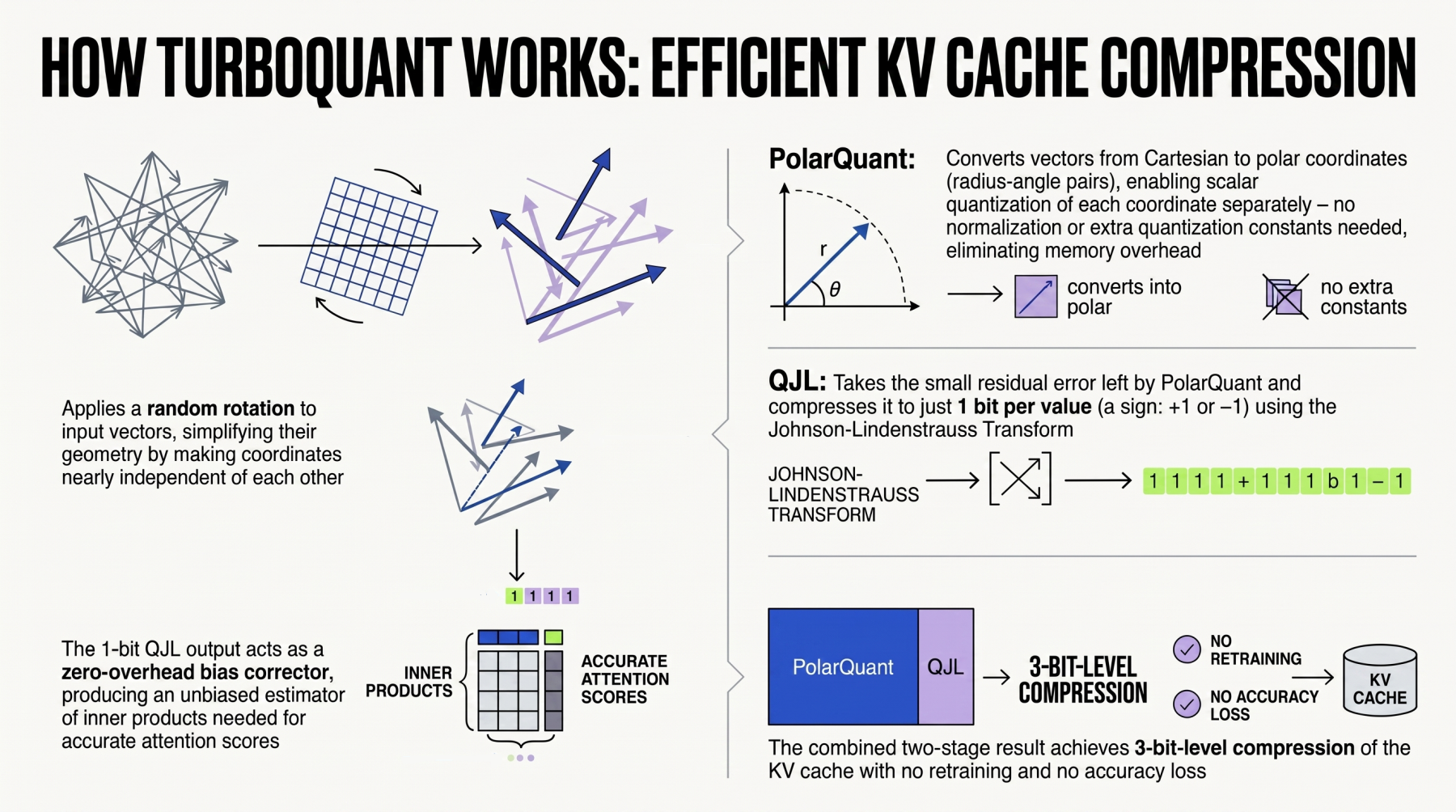
While the original announcement doesn't detail every internal mechanism, TurboQuant is closely tied to KV compression. In transformer-based LLMs, key-value (KV) caches store intermediate attention layers to speed up generation. These caches can become extremely large during long conversations or document processing. TurboQuant applies tailored quantization and compression algorithms to these KV caches, drastically reducing memory consumption. For example, by compressing the KV cache from 16-bit to 4-bit or lower, a model can handle much longer contexts without running out of memory. This is a game-changer for tasks like chatbots or document analysis, where maintaining context over thousands of tokens is essential.
Why is TurboQuant important for LLMs specifically?
Large language models are notoriously memory-hungry. A single model with billions of parameters can require gigabytes of VRAM just to load the weights. During inference, the KV cache multiplies that demand. TurboQuant tackles both problems. For the model weights, it applies low-bit quantization (e.g., 4-bit or 2-bit) while preserving performance, allowing LLMs to run on consumer GPUs or even CPUs. For the KV cache, it reduces the per-token memory footprint, enabling longer sequences. This means developers can deploy more capable models in resource-constrained environments, such as mobile devices or edge servers, without sacrificing quality. It also lowers cloud costs, making AI more accessible.
What role does TurboQuant play in vector search engines?
Vector search engines store and retrieve high-dimensional embeddings (e.g., from text or images) by similarity. These embeddings are often stored as 32-bit floats, leading to massive memory usage in large-scale databases. TurboQuant compresses these vectors into lower bit widths—like 8-bit or 4-bit—while maintaining high recall accuracy. This reduces storage costs by 4x to 8x and speeds up distance calculations. In RAG systems, where an LLM retrieves relevant documents from a vector database before generating a response, faster and cheaper search means lower latency and higher throughput. TurboQuant thus directly enhances the retrieval step, making entire RAG pipelines more efficient.
How does TurboQuant help RAG systems?
RAG (Retrieval-Augmented Generation) combines a retriever (usually a vector search engine) with a generator (an LLM). The retriever fetches relevant information from a large corpus, and the LLM uses that context to produce accurate answers. TurboQuant optimizes both ends. On the retrieval side, compressed vectors allow indexes to fit in faster memory, reducing lookup times. On the generation side, a compressed KV cache lets the LLM ingest longer retrieved documents without hitting memory limits. The result is a system that responds faster, handles larger knowledge bases, and stays accurate. For businesses deploying customer support chatbots or internal knowledge assistants, TurboQuant can dramatically improve performance and cost efficiency.
What kinds of compression techniques does TurboQuant use?
Although Google hasn't released full technical details, TurboQuant likely employs a combination of uniform and non-uniform quantization, group-wise scaling, and adaptive bit allocation. Uniform quantization maps values to a fixed set of levels, while non-uniform can better preserve distribution tails. Group-wise scaling divides tensors into smaller blocks, each with its own scaling factor, improving accuracy. Adaptive bit allocation assigns more bits to important layers or tokens. Additionally, TurboQuant may use dictionary-based compression for frequently occurring patterns. The library provides an easy API so developers can apply these methods without deep expertise in quantization—making advanced compression accessible to the broader AI community.
Is TurboQuant available now and how can I start using it?
Yes, TurboQuant has been recently launched by Google. It is available as an open-source library (likely via GitHub) and integrates with popular frameworks like TensorFlow, PyTorch, and JAX. To start, you can install the package using pip. The library includes pre-built compression pipelines for common model architectures (e.g., Transformer, BERT, T5) and vector databases (e.g., ScaNN, FAISS). You specify your target bit width and accuracy tolerance, and TurboQuant automatically selects the best compression strategy. Example notebooks and documentation guide you through compressing a model or index in minutes. Google also provides benchmarking tools to compare performance before and after compression. For developers working on scalable AI, TurboQuant is a must-try tool to reduce costs and latency without rewriting your entire stack.
Related Articles
- Mastering Tomorrow's Skills: Coursera's New Certifications and Specializations for AI, Finance, Leadership, and More
- 10 Game-Changing Features in IBM Vault 2.0 That Simplify Secrets Management
- Google Unveils TurboQuant: Breakthrough in KV Cache Compression for LLMs
- Data Analyst to Data Engineer: Your 12-Month Self-Study Blueprint
- Empowering Educators: ISTE+ASCD Announces 2026-27 Voices of Change Fellows
- 10 Ways Knowledge Graphs Revolutionize AI Accuracy: From Stale Data to Graph RAG
- freeCodeCamp Launches 13-Hour IT Fundamentals Bootcamp for Absolute Beginners
- Explore Climate Journalism: Carbon Brief's Paid Summer Internship