Mars' Shalbatana Vallis: Unraveling the Red Planet's Watery Past
Mars’ Shalbatana Vallis is a giant scar on the Red Planet that tells a story of violent floods, volcanic upheaval, and a climate that might have once supported an ocean. This vast valley – stretching some 1,300 kilometers near the equator – is a geological treasure chest. Its chaotic terrain, lava‑smoothed plains, and ancient flood marks all point to a Mars that was much warmer and wetter billions of years ago. Below we explore the key questions this remarkable region helps answer.
What exactly is Shalbatana Vallis and how large is it?
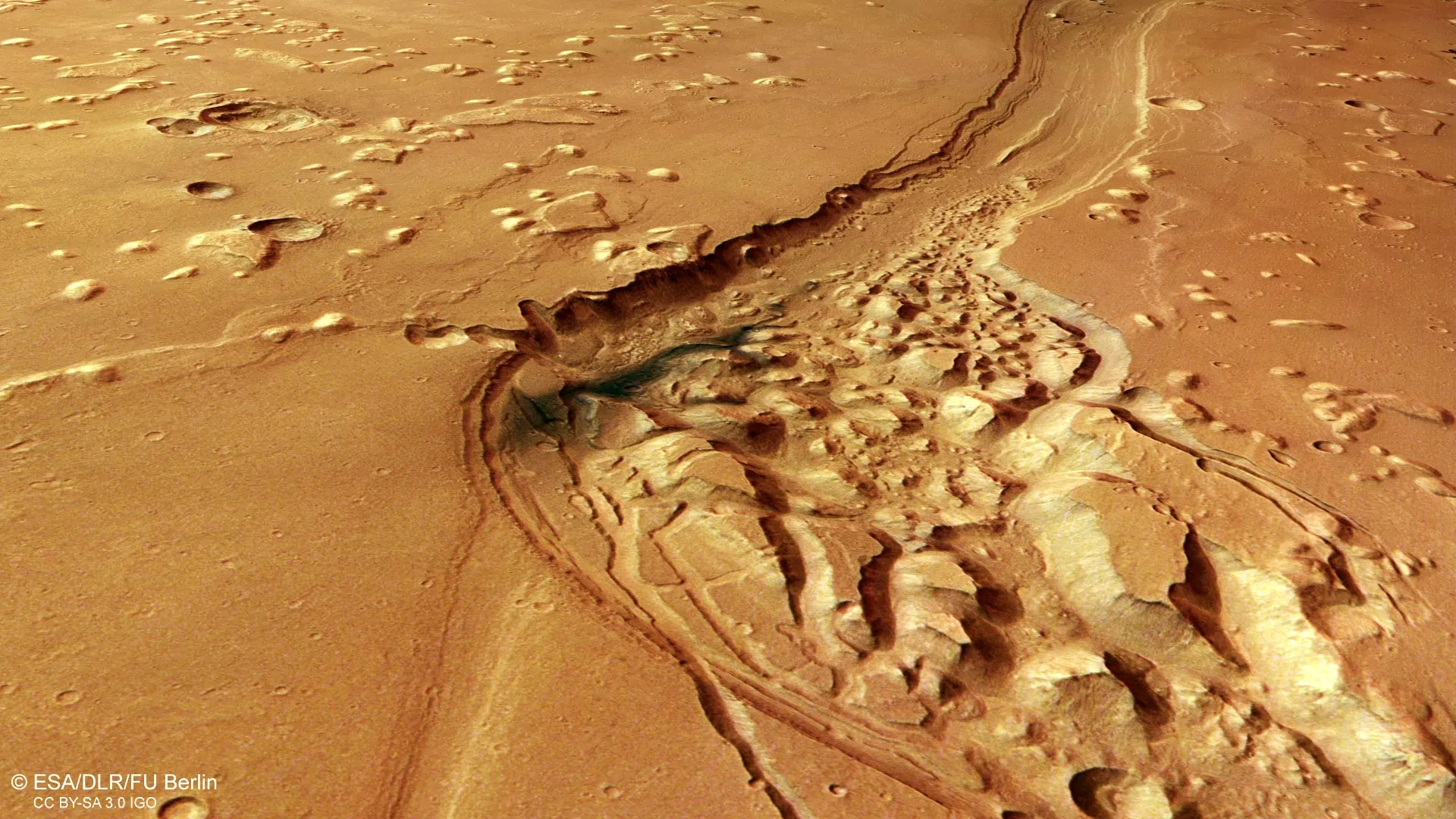
Shalbatana Vallis is a colossal valley system located near Mars’s equator, running approximately 1,300 kilometers in length – roughly the distance from New York City to St. Louis. It belongs to a class of Martian valleys known as outflow channels, which were carved by catastrophic floods of water rather than by slow river erosion. The valley is a complex mix of deep winding channels, collapsed terrain, and smooth plains. Its sheer size and the immense water volume required to carve it make Shalbatana Vallis one of the most compelling pieces of evidence that Mars once had vast amounts of liquid water on its surface.
How was Shalbatana Vallis formed?
The valley formed billions of years ago when enormous reservoirs of groundwater suddenly burst onto the Martian surface. These catastrophic floods gushed across the landscape, gouging out a system of deep, winding channels that we see today. The process likely involved the melting of subsurface ice due to volcanic heating or tectonic activity, causing the ground to collapse and release the water. This chaotic terrain is a direct result of the ground caving in as water was drained away. The floods were so powerful that they could transport huge boulders and sediment over hundreds of kilometers, reshaping the landscape in a matter of days or weeks.
What does 'chaotic terrain' mean in the context of this valley?
Chaotic terrain refers to areas where the ground appears broken into a jumble of blocks, knobs, and depressions, as though a once‑flat surface was shattered from below. In Shalbatana Vallis, chaotic terrain marks the regions where subsurface water was violently released. The loss of water from underground aquifers caused the overlying rock to collapse in an irregular, chaotic pattern. This is a key signature of ancient groundwater floods and is seen in many other outflow channels on Mars. Studying chaotic terrain helps scientists understand both the amount of water that was present and the geological processes that triggered its sudden release.
What other geological features are found in this region besides flood scars?
Besides the dramatic flood channels and chaotic terrain, Shalbatana Vallis contains several other important features. These include:
- Lava‑smoothed plains – vast areas where volcanic eruptions later covered the landscape with basaltic lava, erasing older features.
- Volcanic ash deposits – fine tephra from explosive eruptions, indicating a history of both effusive and explosive volcanism.
- Battered impact craters – many craters are heavily eroded, suggesting they formed before or during the flood events and were later modified by water and lava.
This combination of water‑carved, volcanically altered, and impact‑scarred terrain makes the valley a microcosm of Mars’s geological history.
What clues does Shalbatana Vallis provide about Mars' past climate?
The valley’s features strongly suggest that Mars’s climate billions of years ago was far warmer and wetter than today. The massive groundwater floods imply a stable hydrological cycle, with precipitation recharging underground aquifers – a process that requires a thicker atmosphere and higher temperatures. The presence of volcanic ash and lava flows further complicates the picture, as volcanism could have released greenhouse gases that helped keep the planet warm. Together, these clues indicate that Mars probably experienced long periods with liquid water on its surface, possibly even an ocean in the northern lowlands. The valley’s age, around 3.5 billion years, places it in the late Noachian to early Hesperian periods, when conditions were most favorable for life.
Does this valley support the idea of a Martian ocean?
Yes, indirectly. Shalbatana Vallis drains into the northern lowlands of Mars, which many scientists believe once held a vast ocean. The volume of water needed to carve this valley is enormous – estimated to be equivalent to several times the water in Earth’s Lake Superior. If other similar outflow channels also contributed, the total water volume could have been enough to form an ocean covering much of the northern hemisphere. While Shalbatana Vallis alone cannot prove an ocean existed, it provides a crucial piece of evidence that large bodies of stable liquid water were present on early Mars.
How do scientists study this region from Earth?
Researchers use a combination of methods. High‑resolution images from orbiters such as NASA’s Mars Reconnaissance Orbiter and Mars Express allow them to map the valley’s topography, identify different rock layers, and measure the shapes of channels. Chaotic terrain is analyzed by counting collapsed blocks and estimating the volume of removed material. Spectroscopy helps identify minerals like clays and sulfates that form in water. Computer simulations also model the flood dynamics. By piecing together these remote sensing data, scientists reconstruct the valley’s history and infer the ancient climate conditions that made such a dramatic landscape possible.
Related Articles
- Antimatter Atom Reveals Wave Nature in Landmark Quantum Experiment
- Amazon WorkSpaces Empowers AI Agents with Secure Desktop Access for Legacy Applications
- Artemis III Earth Orbit Test Delayed to Late 2027 Amid Lander Development Challenges
- Stunning Starlink Satellite Video Reveals Earth from Orbit
- The $573 Million Web: 10 Key Revelations from Tesla’s Latest Filing About Elon Musk’s Companies
- Blast Off Instantly: Capcom’s PRAGMATA Lands on GeForce NOW – No Hardware Required
- 10 Fascinating Facts About Earth's Mysterious Ring Current and the New Mission to Uncover Its Secrets
- 8 Critical Insights into How RNA's First Letter Shapes Antiviral Defenses