7 Critical Insights into the CPU-Z Watering Hole Attack and How SentinelOne Stopped It
On April 9, 2026, a sophisticated watering hole attack targeted users of CPU-Z and other system monitoring tools. Threat actors compromised the official CPUID domain at the API level, redirecting legitimate download requests to malicious infrastructure for 19 hours. Users who visited cpuid.com received a properly signed binary—but with a hidden payload. SentinelOne’s AI-powered EDR detected the anomaly within seconds and autonomously blocked the attack. Here are seven key insights into this incident and what it reveals about the evolving software supply chain threat landscape.
1. The Attack Timeline: 19 Hours of Silent Compromise
The assault began on April 9, 2026, when attackers gained API-level access to cpuid.com. For approximately 19 hours, any user downloading CPU-Z, HWMonitor, or similar tools through the official site received a legitimate-looking binary bundled with malicious code. The attack flew under traditional security radars because the digital signatures were valid and the download originated from the vendor’s own infrastructure. Only behavioral analysis—what the software did after execution—could expose the threat. This timeline underscores the stealth and patience of modern supply chain attacks.

2. How the CPU-Z Attack Worked: API-Level Domain Compromise
Rather than defacing the website or swapping files, the attackers compromised the CPUID domain at the API layer. This allowed them to silently intercept download requests and reroute traffic to attacker-controlled servers. Users who navigated directly to the official URL received a binary that looked and signed correctly but carried a malicious payload inside. The method demonstrates a shift from traditional malware distribution—where users are tricked into downloading from shady sources—to compromising the trusted distribution channel itself. It’s a classic man-in-the-middle attack elevated to the supply chain level.
3. The Trust Chain Breach: Why Even Expert Users Were Vulnerable
CPU-Z, HWMonitor, and similar tools are staples in IT toolkits worldwide. System administrators, hardware enthusiasts, and enterprise security teams trust these utilities. In this attack, the trust chain broke far above the user: the vendor’s download infrastructure was weaponized. Users followed every best practice—downloading from the official site, verifying signatures—yet were still exposed. This breach highlights a critical vulnerability: when a trusted supplier is compromised, even the most security-conscious user cannot detect the threat without runtime behavior monitoring.
4. SentinelOne’s Behavioral Detection: The Anomaly That Saved the Day
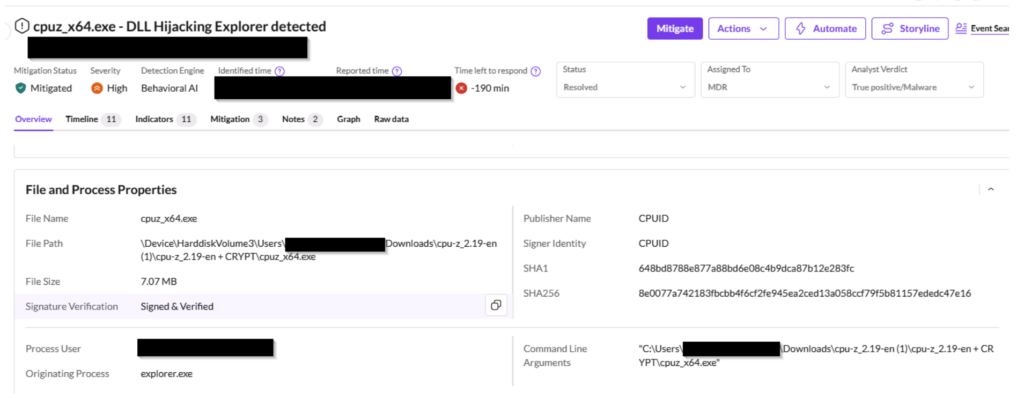
The SentinelOne agent flagged the threat within the first seconds of execution. The alert, “Penetration framework or shellcode was detected,” fired based on what the process did rather than what it was. The genuine cpuz_x64.exe binary spawned PowerShell, which then spawned csc.exe, which spawned cvtres.exe. CPU-Z never does that. This behavioral chain—unusual child processes and reflective code execution—was the tell. SentinelOne’s AI EDR correlates multiple low-level signals to detect attacks that bypass signature-based defenses.
5. Five Behavioral Indicators That Flagged the Threat
The detection relied on five converging behavioral indicators, each benign alone but dangerous together:
- Anomalous API resolution: The process located system functions through non-standard methods, bypassing the OS loader.
- Reflective code loading: Executable code ran in memory regions without a corresponding file on disk.
- Suspicious memory allocation: Read-Write-Execute (RWX) permissions were requested—a common prep pattern for payload injection.
- Process injection patterns: Execution flow consistent with code being redirected into a secondary process to mask its origin.
- Heuristic shellcode signatures: Sequential operations characteristic of automated exploitation toolkits preparing commands.
These signals converged within seconds, enabling autonomous action.
6. The Broader Supply Chain Shift: Why This Attack Matters
SentinelOne’s Annual Threat Report identifies this pattern as a systemic shift: “the identity of a trusted developer becomes the vector of attack.” Previous campaigns, like GhostAction (late 2025), used compromised maintainer accounts to push malicious workflows. Another attack phished an NPM maintainer to intercept cryptocurrency transactions. In each case, commit logs appeared legitimate because credentials were valid—but intent had been subverted. The CPUID incident extends this to software distribution: the supplier’s download infrastructure became the delivery channel. This is not a one-off; it’s the new normal.
7. Autonomous Response: How SentinelOne Stopped the Attack in Seconds
Once the behavioral indicators triggered the alert, the SentinelOne agent autonomously terminated and quarantined the involved processes. The malicious payload—a CRYPTBASE.dll placed inside the installer—never got a chance to execute its full chain. This automated response prevented data exfiltration, lateral movement, or further compromise. In a world where attacks happen in minutes and humans can’t keep up, AI-driven autonomous EDR provides the only realistic defense against supply chain attacks that abuse trust.
The CPU-Z watering hole attack is a stark reminder that software supply chain threats are evolving. Trusting the source is no longer enough; you must also trust the behavior of the software after it runs. SentinelOne’s AI EDR offers a blueprint for detecting and stopping these sophisticated attacks before they cause damage. By focusing on what processes do rather than where they come from, organizations can break the attack chain—even when the supply chain is compromised.
Related Articles
- Selecting the Optimal Peristaltic Pump for Your Fluid Transfer Needs
- Shadow AI Apps Expose Sensitive Data at Scale: 380,000 Vibe-Coded Assets Found Publicly Accessible
- The Unmasking of UNKN: 10 Key Facts About the Mastermind Behind GandCrab and REvil Ransomware
- April 2026 Patch Tuesday: Record-Breaking Vulnerabilities and Active Exploits
- 7 Critical Lessons from the CPU-Z Watering Hole Attack: How AI EDR Stopped a Supply Chain Breach
- How Debian's Upcoming Release Blocks Tampered Binaries: Your Questions Answered
- How the DEEP#DOOR Python Backdoor Compromises Systems: A Step-by-Step Analysis
- Mandiant M-Trends 2026: Critical Cybersecurity Insights from the Frontline