Mastering Enterprise Secret Management in Kubernetes with Vault Secrets Operator (VSO)
Enterprise platform teams running Kubernetes often face a critical gap: managing secrets at scale without compromising security or slowing development. Native Kubernetes Secrets lack the governance, lifecycle automation, and centralized control required for production environments. HashiCorp Vault has become the go-to centralized secrets manager, but integrating it with Kubernetes traditionally involved multiple patterns with different tradeoffs. The Vault Secrets Operator (VSO) emerges as the modern, Kubernetes-native solution that standardizes secret delivery, rotation, and revocation while preserving developer workflows. Below, we answer common questions about VSO and how it transforms enterprise secret management.
Why do native Kubernetes Secrets fall short for enterprise use?
Native Kubernetes Secrets are base64-encoded, not encrypted at rest by default, and lack fine-grained access controls, audit logs, and automated lifecycle management. In enterprise environments with multiple clusters across clouds, managing secret rotation, revocation, and policy enforcement becomes impossible. Secrets stored in etcd are vulnerable to unauthorized access if RBAC is misconfigured. Moreover, Kubernetes Secrets are platform-specific — they cannot be easily shared with non-Kubernetes workloads, breaking the need for a centralized, platform-agnostic secret store. Teams end up needing a solution that handles the entire secret lifecycle from generation to revocation, which native secrets simply weren't designed for. This is where external secrets managers like Vault become essential.
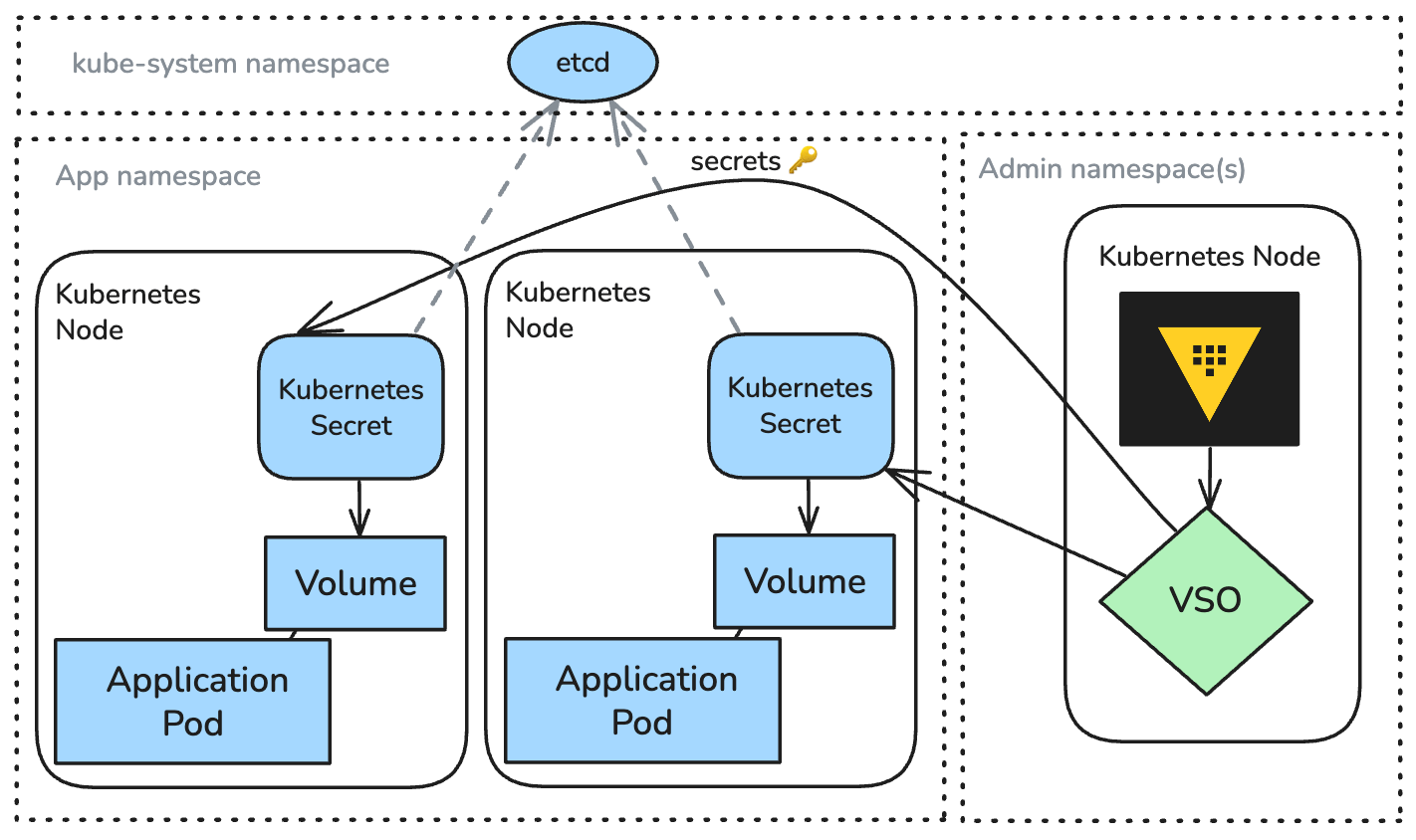
What is the Vault Secrets Operator (VSO) and how does it work?
The Vault Secrets Operator (VSO) is a Kubernetes-native operator that synchronizes secrets from HashiCorp Vault into Kubernetes secrets or directly into pods via CSI. It runs as a controller in your cluster, watching custom resources like VaultStaticSecret or VaultDynamicSecret. When a secret in Vault is created or rotated, VSO automatically pulls the new value and updates the corresponding Kubernetes secret, ensuring pods always have access to the latest version. VSO eliminates the need for sidecar containers or manual scripts. It integrates with Vault's identity-based access policies and supports both static and dynamic secrets, making it a single, consistent interface for secret delivery across clusters. Because it extends the Kubernetes API, developers interact with familiar resources without changing application code.
How does VSO compare to other Vault integration patterns like sidecar injector or CSI driver?
Older patterns include the Vault Agent Sidecar Injector, which adds a sidecar container to each pod to fetch and renew secrets. While functional, it increases resource overhead, pod startup time, and operational complexity. The Secrets Store CSI driver (SSCSI) mounts secrets as volumes, but it requires CSI infrastructure and cannot easily handle dynamic secrets or complex rotation policies without reloading volumes. Third-party operators (e.g., External Secrets Operator) add extra layers and may lag in Vault feature support. VSO directly addresses these shortcomings: it runs as a single operator per cluster, uses Kubernetes secrets as the stable interface, supports native Vault rotation events, and works with any pod runtime. It's designed to be the recommended standard for most use cases, combining simplicity, security, and lifecycle automation.
What specific benefits does VSO bring to enterprise Kubernetes environments?
VSO delivers several key benefits. Security: Secrets are never stored in etcd unless encrypted with Vault's transit engine. Lifecycle automation: It automatically handles secret creation, rotation, and revocation based on Vault policies — no manual intervention. Developer productivity: Developers continue using standard Kubernetes secrets without changing their code or learning new APIs. Scalability: One operator can manage thousands of secrets across multiple clusters. Observability: Integrates with Vault audit logs and Kubernetes events. Policy enforcement: Leverages Vault's identity-based access and can enforce secret version pinning. These features reduce operational burden on platform teams while meeting compliance requirements like auditable secret rotation and least-privilege access.
How does VSO integrate with Red Hat OpenShift?
With the deepening partnership between HashiCorp and Red Hat (via IBM), VSO is fully compatible with OpenShift. It installs via OperatorHub or Helm and respects OpenShift Security Context Constraints (SCCs). VSO works with OpenShift's built-in monitoring and can use OpenShift Routes for Vault connections. The operator can manage secrets for OpenShift-specific workloads like Deployments and StatefulSets. Because OpenShift is a hardened Kubernetes distribution, VSO leverages its security enhancements (e.g., pod security policies) while adding centralized secret lifecycle management. This combination makes it a powerful choice for enterprises running OpenShift who want to maintain their security posture without sacrificing developer velocity. OpenShift administrators can enforce Vault-backed secrets as the standard across all namespaces.
How does VSO automate the entire secret lifecycle (generation, rotation, revocation)?
VSO watches for secret changes in Vault using event notifications or periodic polling. When a secret is created or updated in Vault, VSO immediately synchronizes it to the matching Kubernetes secret. For rotation, VSO can use Vault's TTL-based dynamic secrets (like database credentials) and automatically renew them before expiry — with zero pod restarts if configured via CSI. For static secrets, it checks for version changes. Revocation is handled through Vault's lease management: when a lease expires or is revoked, VSO removes the secret from Kubernetes or marks it as invalid. The operator also respects spec.refreshAfter intervals. This means platform teams define policies once in Vault, and VSO ensures enforcement across all Kubernetes workloads without custom scripts, greatly reducing misconfiguration and security gaps.
Related Articles
- Over 1 Million Downloads: Open Source Toolkit Caught Stealing Cloud Credentials, API Keys
- Cyberattack Disrupts Finals on Instructure's Canvas Platform
- How MSPs Overcome the Top 5 Sales Hurdles Hindering Cybersecurity Revenue Growth
- Building a Three-Axis Camera Slider with Repurposed 3D Printer Components
- The Ultimate Guide to Launching a Career as a Cybersecurity Consultant
- Multi-Stage Cyber Attacks: The Invisible Assassins of Modern Security
- Cloudflare's Proactive Defense Against the Copy Fail Kernel Vulnerability
- Exploiting Trust: How Phishers Use Amazon SES to Evade Email Filters